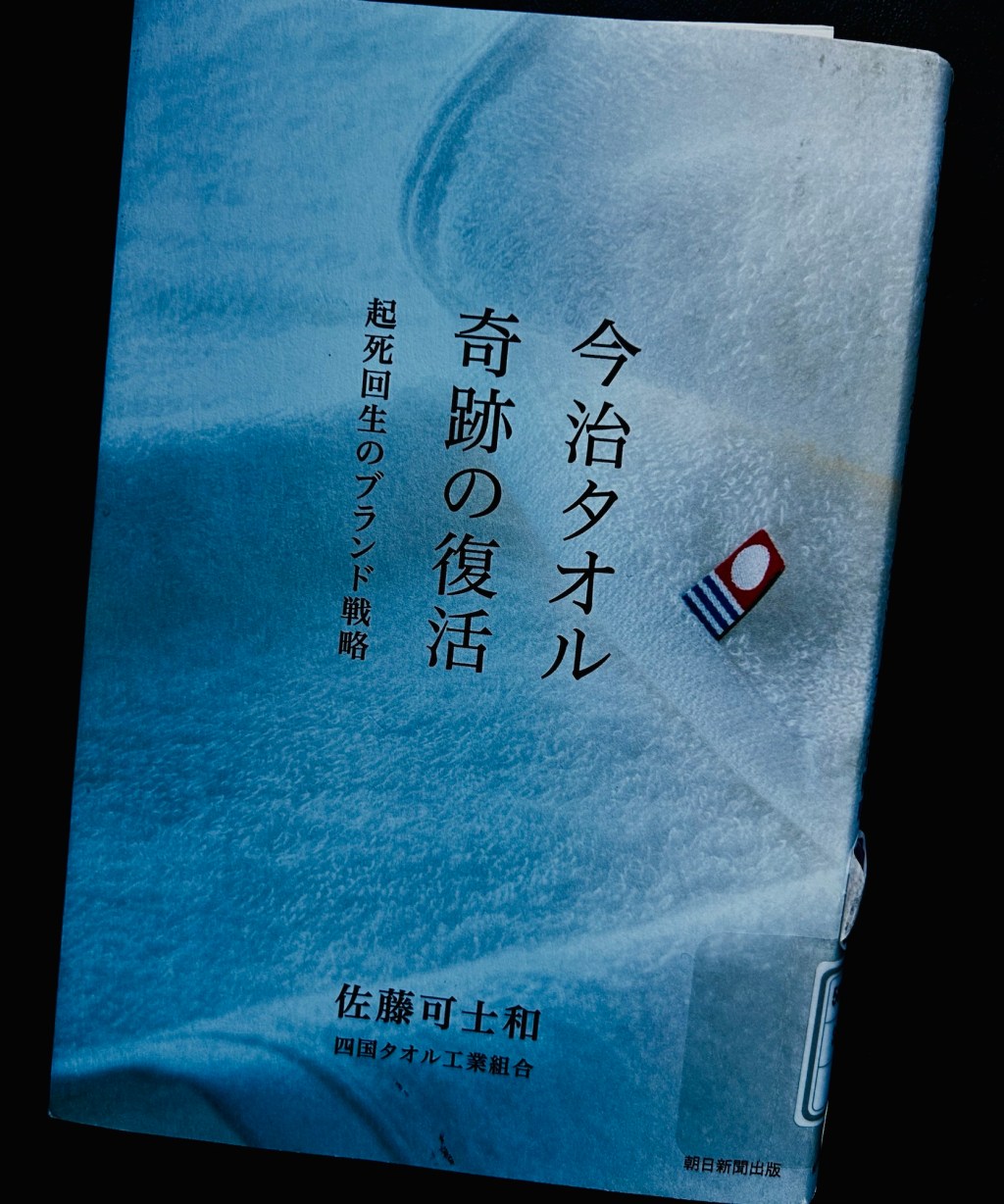
Reviving a local industry that had fallen into decline after losing out in competition to cheap manufacturers from emerging economies.” It was co-authored by Kashiwa Sato, who is involved in the strategy of Imabari Towel in Imabari City, Ehime Prefecture, and the Shikoku Towel Manufacturers Association, which is a party to the project.
The book is a great learning experience for iU students as a successful case study of using brand marketing as a solution to a business challenge.
Challenges of the Imabari Towel Industry
First, the challenges faced by the Imabari towel industry: What does it mean to be “defeated by foreign manufacturers”?
One of the factors seems to be the business structure.
This is the order in which towels reach consumers from the towel factories in Imabari: manufacturer → wholesaler → retailer.
This is the order in which towels are delivered from the Imabari towel factory to consumers. The system and order in which goods and services are delivered to consumers is called a “supply chain.
Wholesalers are the key players in the supply chain. Wholesalers use their position close to retailers to read future trends based on product sales trends, plan products that will sell, and develop them with manufacturers. They play such a commanding role.
What about manufacturing = manufacturers? Manufacturers also want to make and sell products that they themselves have planned. Ideally, this would be ideal, but in reality, this is not always the case.
They may be far away from the place of final consumption, or they may not have the resources to visit stores.
As a consumer, as a professional, or as a company, it is difficult to understand what kind of products consumers want.
What if the towels we planned and manufactured ourselves were to go unsold? Such inventory risks are on their minds.
Wholesalers provide manufacturers with the marketing and financing functions that manufacturers need to deal with such problems.
The wholesaler can provide the manufacturer with the marketing and financing functions to meet the manufacturer’s needs, such as, “This is the towel trend for next year,” or “I want 5 million towels made by the new season.
Towel manufacturers do not need to worry about the risk of unsold towels or what to make as long as they fulfill orders from wholesalers.
All they have to do is run the machines and deliver the number of towels ordered.
They are passive, but the money goes around. This is the state of affairs. As you can see in the quote below, it was just like a “drug”.
The more time passes, the more the manufacturer becomes an entity that does the work at the behest of the client (wholesaler).
And if there is another “supplier” with a lower price, the order is immediately changed (including other countries).
If there is another company that is cheaper, they will immediately change the supplier (including those in other countries). There are plenty of other companies. It was a world like Naoki Hanzawa, Japanese poplular business drama.
By the time they realize it, they have no sales channels left and have no choice but to go bankrupt.
The following is a quote from the book, which describes exactly how towel manufacturers in Imabari fell into this vicious cycle.
“Around the late 1970s, the focus of work for Imabari towel makers began to shift to OEM. The wholesalers’ reliance on the popularity of licensed designer brands meant that they had fewer and fewer opportunities to plan and sell their own products.” (quoted)
“We were also manufacturing towels for brands such as Burberry, Celine, and Missoni on consignment, but in an era when towels from famous foreign brands were selling left and right, OEM was like a “drug”. It was not easy in terms of price, but I just couldn’t stop…” (quoted)
“We were immersed in the structure of Europe’s brand dependence. Although this was the path they had chosen for themselves in the trend of the times, the fact that they had ceded control of their business to the wholesalers had resulted in the weakening of their member companies.” (quoted)
In the end, the initiative passed to the wholesalers, and based on economic rationality, orders stopped coming to Imabari.
“Around 2004, when my term as president was about to expire, it seemed like every month some company was going bankrupt, and there were many members who thought they would be better off if they left the union early.” (quoted)
This is where it all started in the first place. Perhaps it is a problem that every once thriving region is facing, a decline in prosperity.
So, finally, a local project is started to develop a direct sales channel.
Then, we are faced with the second challenge.
Brand Strategy
“Imabari towels have always had a good reputation for quality, even winning awards at international trade shows, but we had not yet reached the point where we could sell products under the Imabari brand.” (quoted)
“There are a number of manufacturers in Imabari who have won awards abroad, but even if they are recognized for their products, they have yet to sell their products. But even if they are recognized for their products, whether they are willing to pay for them or not is another story. Japanese towels are expensive, and that is the reason why we have not been able to turn our superior technology into a business” (quoted)
The quality is good, but they don’t sell.
This is where Mr. Kashiwa Sato comes in.
The supply chain, which used to be driven by the market-in approach of wholesalers, is now being rethought based on the product-out approach of “good quality + brand power.
The company began activities to uncover demand through the power of the brand.
Kashiwa Sato developed three strategies to “win with the brand, not the price”:
(1) establish a brand logo
(2) start directly-managed stores in Tokyo
(3) establish a towel sommelier certification system.
The brand logo of “Imabari Towel” is based on the initial “i” of “Imabari” (IMABARI) and represents the sun and the sea, etc., which are associated with the city of Imabari facing the Seto Inland Sea.
Towels made in Imabari are always marked with this brand tag, and now you can tell which company produced the towels, etc.
Towel companies say, “We used to have a badge on our collars.
In the past, when people saw the badge on the lapel, they would ask, “What kind of mark is that? But now, wherever they go, they can tell at a glance that it is the brand mark of Imabari Towel. When I was on an airplane, I was asked by a stranger, “Are you from Imabari Towel? When I board airplanes, I am now approached by strangers who ask, ‘Are you from Imabari Towel?
It is clear that the establishment of the brand logo has created a sense of unity and pride in the region, as well as quality control of the towels.
Directly-managed store Tokyo
Next, to expand recognition of the Imabari brand, a directly managed store was opened in Omotesando, Tokyo.
The purpose of this directly-managed store is to allow people to actually hold Imabari towels in their hands, even if they are in the red.
The store will have a simple and stylish interior with all Imabari towel products and will serve as a window not only for highly sensitive users, but also for the media and other media.
Towel Sommelier Certification System
In addition, we are starting a towel sommelier certification test to train people to convey the brand. The Shikoku Towel Manufacturers’ Association will cooperate with local companies to certify as sommeliers those who have mastered the following seven knowledge points.
(1) History of towels, (2) Manufacturing process of towels, (3) Terms related to towels, (4) Types of towels, (5) Distribution of towels, (6) How to recommend towels to customers, and (7) Others.
Towel sommeliers play an important role in communicating directly with users at directly managed stores.
They have created a system to improve and maintain the quality of “sales” and “marketing,” which the manufacturer had not been able to do.
The Difficulty of Protecting a Brand – A Brand for the Entire Production Area
“The difficulty is not in “creating” a brand, but in “protecting” it. “
If it has the Imabari towel brand logo on it, it will sell. At such a time, a local towel company, planning to further increase sales, implemented such measures as creating a new premium line and having Kabuki actors use their towels.
When Kashiwa Sato saw this, he said angrily, “You guys are still trying to do this? He was furious.
He was angry because, if a premium line was created, the current “Imabari brand” would be perceived as a relatively low-ranked brand.
Mr. Sato says, “Imabari towels are a class of towels.
“Imabari towels are like an honor student in the class. They don’t break school rules and are good at studying. That’s what we mean when we say ‘safe, secure, and high quality. A student who is always serious and is appointed president of the student council suddenly tries to be funny by doing a comic act, but it is not funny at all, is it? That’s what you guys were trying to do. If you look at the students in the corner of the classroom, you may think you are not interesting enough, but Imabari Towel can remain an honest student body president.” (quoted)
It is difficult to start a brand from scratch, but it is also difficult to maintain it. It is all very difficult.
Characteristics of Imabari Towel
Towels are daily-use products that are washed every day. Water is used to process the cotton threads that make the towels, and whether the water is soft or hard makes a difference in the finished product.
“When I traveled to Europe before, I always wondered why the towels here had such thick and stiff yarns, but now I understand why. Thick and strong yarns are used to increase durability. The reason they don’t feel good on the skin is that after repeated washings, the lime matter gets stuck to the fibers and makes them crispy.” (Quoted)
The water in Imabari is soft.
“The Sohja gawa River, which originates in the mountain range, flows through Imabari, and the city is blessed with abundant groundwater. Its water is subsoil water with low hardness and extremely low heavy metals. Natural, high-quality soft water plays an important role in the processing of cotton.” (quoted)
“The surface of the yarn is covered with natural oils and waxes that repel water. Removing them in the bleaching process creates water absorbency, but removing them completely sacrifices softness and causes the fabric to become crispy after repeated washing. The delicate process of bleaching with good water, taking time and care, and leaving “just the right amount” of oil and waxiness produces towels that are comfortable to use.” (quoted)
The soft and pleasant feel of Imabari towels was due to the abundance of soft water and careful processing techniques.
Success of the production area brand
Originally, the Imabari Towel Planding Project was an initiative started by the towel industry to overcome the crisis of the survival of the production area.
Gradually, these activities led to the revitalization of not only the towel industry but also the local economy.
Contributing to the local economy while protecting local jobs is a prerequisite for the development of the local industry. I remember how happy I was when I attended the ceremony as president of the association, because I felt that our activities had contributed to the revitalization of the region, and that the local people were happy and proud of our activities. At the same time, I felt a sense of humility that we still have a lot of work to do in order to continue to prosper together with the local community.
Conclusion
So, this book is about,
(1) The structure and challenges of the “manufacturer-wholesaler-retailer” supply chain
(2) Brand strategy to sell high quality products
The book is available at the iU library, so if you are interested, you can borrow it.
 合同会社小村井オムライス